
Functional exercises are movement patterns designed to train your body for real-world activities, the actions you do every day like standing up from a chair, climbing stairs, lifting groceries or reaching overhead. These exercises help you build strength, balance, mobility, endurance and coordination, all essential for aging with independence and vitality.
What are functional exercises?
Functional exercises are purposeful movements that mimic everyday tasks. Instead of isolating a single muscle like in traditional bodybuilding, they combine multiple joints and muscle groups to enhance real-life performance.
The focus is on natural human movements like pushing, pulling, squatting, hinging, balancing, carrying and rotating … exactly what your body does during daily activities.
Unlike machine-based workouts, functional training prepares your body to move efficiently in all planes of motion and supports daily independence as you age.
Why functional movement is vital for longevity
As we age, changes in muscle, joints, hormones and metabolism can lead to common physical issues like:
- Muscle loss and weakness (sarcopenia), making everyday tasks harder.
- Joint pain and stiffness, particularly in knees, hips and shoulders.
- Reduced bone density, increasing fracture risk.
- Lower back discomfort due to posture changes and core weakness.
- Balance and mobility issues, raising fall risk.
- Loss of flexibility and slower recovery after activity.
- Metabolic and cardiovascular challenges.
As you age, your body undergoes predictable changes, like muscle loss, slower gait, balance decline, reduced joint mobility and lower aerobic capacity. These changes directly affect functional independence, aka your ability to perform daily activities safely and confidently.
1. Functional strength and physical capacity
Functional training targets multiple muscle groups and movement patterns that mirror daily life, like standing from a seated position, pulling, pushing, stepping up and carrying objects. Research has found that functional exercise programs significantly improve overall physical capacities in adults over 60, including strength, power and functional performance.
2. Mobility, balance and reduced disability
A major systematic review and meta analysis of randomized, controlled trials published in Geriatric Nursing showed that older adults who participated in functional exercise had improved gait speed, balance measures, step length and mobility tasks compared with controls. These outcomes are directly tied to reducing disability risk and supporting daily living.
3. Daily living skills
Functional programs have been shown to improve performance in activities of daily living, including tasks like climbing stairs, rising from chairs and carrying groceries. This in turn helps prolong independent living and quality of life.
4. Core and dynamic stability
Functional workouts enhance core strength and neuromuscular coordination, helping stabilize the spine and pelvis during everyday movement. This is crucial for preventing falls and lower back strain.
Functional exercises directly address these issues by strengthening muscles, improving joint stability, enhancing balance and keeping your body adaptable, which makes everyday life easier and helps protect against age-related declines.
Best functional exercises for healthy aging
Below are functional moves organized by movement type. Aim for two sets of eight to 12 reps each (unless otherwise noted) two to three days per week to build strength and resilience you can feel every day.
1. Lower body (strength for daily movements)
Lower body strength supports essential tasks like sitting, standing and walking.
- Squats and chair stands train standing up and sitting down safely.
- Step-ups target stair climbing and leg strength.
- Reverse lunges improve walking mechanics and balance.
- Hip hinges and deadlifts teach safe bending and lifting.
Bodyweight squats

To perform a free-standing squat, stand with feet about shoulder-width apart and toes slightly turned out. Engage your core, keep your chest upright, and begin the movement by pushing your hips back and bending your knees as if sitting into a chair.
Lower until your thighs are parallel to the floor or as low as your mobility allows, keeping your heels grounded and knees tracking over your toes. Press through your heels to return to standing.
Advanced version: Use dumbbells.
Step-ups

Step one foot onto a sturdy platform or step, press through the heel to lift your body up, then step back down with control and repeat on the other side. You may need to hold on to a support, such as a banister, while doing the move.
Advanced version: Use a dumbbell.
Reverse lunge

Holding dumbbells at your sides, step one foot back into a lunge, lower until both knees are bent, then push through the front heel to return to standing and switch sides. Advanced version: Use a dumbbell.
Hip hinges (with resistance bands)

With a neutral spine, push your hips back while keeping a slight bend in the knees, then drive the hips forward to return to standing. Advanced version: Deadlift with dumbbells.
2. Upper body (push and pull movements)
Upper-body functional strength helps with tasks like opening doors, lifting objects and reaching shelves.
- Push-ups (wall, incline or floor) train pushing strength.
- Rows (bands or dumbbells) strengthen upper back and posture.
- Overhead press builds shoulder and arm strength for lifting.
Wall push-ups

Standing arm’s length from a wall, place your hands on the wall and lower your chest toward it, then press back to the starting position with control. Advanced: Regular push-ups
Dumbbell rows

With a flat back and core engaged, pull the dumbbells toward your hips, squeeze your shoulder blades together, then lower with control.
Dumbbell overhead press

Sit on a bench or study chair. Press the dumbbells overhead until arms are extended, then lower them back to shoulder height with control.
3. Core and stability
A strong core supports your spine and improves coordination, posture and movement efficiency.
- Planks are a whole-body stability builder.
- Bird dogs train lower back and spinal support.
- Dead bugs aim for core control without back strain.
Plank

Hold a straight line from head to heels while engaging the core, glutes and shoulders. For each set, do two 30-second holds.
Bird dogs

From a hands-and-knees position, extend the opposite arm and leg, keep the core engaged, then return with control, and switch sides.
Dead bugs

Lying on your back, extend opposite arm and leg while keeping your core engaged and lower back pressed into the floor, then return to start and switch sides.
4. Balance and fall prevention
Balance training reduces fall risk, a major concern as we age.
- Single-leg stands improve unilateral balance.
- Heel-to-toe walking trains stability while walking.
- Step-and-hold drills challenge dynamic balance.
Single-leg stands

Stand on one leg with your core engaged, hold the position with control, then switch sides. Hold the position for 20 to 30 seconds per side.
Heel-to-toe walking
Walk forward by placing the heel of one foot directly in front of the toes of the other, keeping your core engaged and posture upright. Aim for 10 to 20 slow, controlled steps.
Step-and-hold drills
Step forward or to the side, pause briefly to stabilize on one leg, then return to the starting position and repeat. Perform five to 10 reps per side.
5. Carry and grip strength
Grip and carry strength help you manage groceries, luggage and other physical loads.
- Farmer’s carries involve walking while holding weights.
- Suitcase carries are unilateral carry moves that strengthen core and grip.
Farmer’s carry
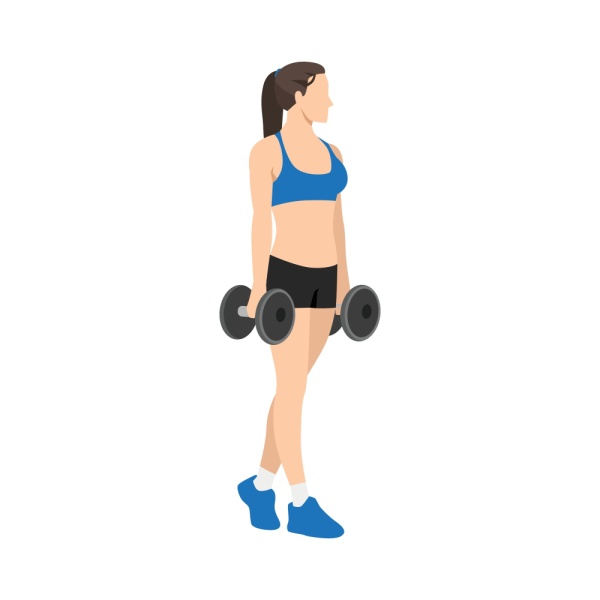
Hold weights at your sides, stand tall and walk forward with controlled steps while keeping your core engaged. Aim for 20 to 40 seconds per set or a distance of about 20 to 40 yards.
Suitcase carry
Hold a weight in one hand at your side, walk forward with controlled steps while keeping your torso upright, then switch sides. Aim for 20 to 40 seconds per side or about 20 to 40 yards.
6. Rotation and mobility
Rotational and mobility drills keep your torso and hips flexible and functional.
- Torso rotations are done with a band or medicine ball.
- Standing chops and lifts for dynamic rotational strength.
Torso rotations (with medicine ball)
Stand with feet about shoulder-width apart, and hold a medicine ball at chest height with both hands. Rotate your torso side to side with control while keeping hips stable and core engaged. Do both sides.
Standing chops

Using a weighted cable or resistance band, pull the weight diagonally across your body with control while keeping your core engaged and hips stable. Do both sides.
Benefits of functional exercise
Functional training delivers powerful benefits that go far beyond aesthetics, especially for aging adults.
1. Improves daily movement
Functional exercises mirror everyday actions, like walking, bending, lifting, pushing and reaching, so your body moves more efficiently and with less effort.
This type of training emphasizes movement patterns, not isolated muscles, so improvements directly transfer to everyday tasks. This specificity enhances real-life capability and performance.
2. Builds strength and bone health
Resistance, balance and bodyweight exercises help preserve muscle mass and bone density, crucial for preventing frailty and fractures as you age. Older adults have shown measurable gains in strength when undertaking functional routines that include resistance, balance and mobility components, helping counteract age-related muscle loss.
3. Enhances joint mobility
Functional moves promote joint range of motion and reduce stiffness, helping you stay limber and comfortable.
For example, an eight-week, randomized, controlled trial in healthy male university students found that participants who performed a structured functional training program, which emphasized integrated, multi-joint, multi-plane movements, showed significantly greater improvements in measures of functional movement quality (including dynamic stability and core control) compared with those in a traditional training program, indicating enhanced joint mobility and movement capability in daily tasks.
Another randomized, controlled trial in older women (mean age of 65 to 70) published in the Journal of Sports Medicine and Physical Fitness compared functional training with traditional training and found that after 12 weeks both groups improved strength and joint mobility, but the functional training group showed statistically significant improvements in dynamic agility/balance and determinants of gait ability.
These results suggest that functional exercises that integrate multiple joints and everyday movement patterns can more effectively enhance joint mobility and related functional performance in older adults.
4. Supports balance and fall prevention
Balance drills train your nervous system and proprioception, lowering your risk of falls, a major concern for older adults. Functional training also improves balance, gait stability and coordination, which are key predictors of fall risk.
Multiple studies have reported significant improvement in balance scores after functional interventions.
For instance, a randomized, controlled, crossover trial in older adults published in the Journal of Frailty, Sarcopenia and Falls found that a balance exercise circuit program significantly improved postural balance, muscle strength and functional mobility and was associated with a reduction in fall risk during follow-up compared with periods without the intervention. This indicates that structured functional balance exercises can enhance mechanisms that help prevent falls.
Another randomized clinical trial of a home-based strength and balance retraining exercise program for community-dwelling older adults at high fall risk demonstrated that, over 12 months, the exercise group experienced a significant reduction in fall incidence compared with usual care, supporting the role of combined functional balance and strength training in real-world fall prevention.
5. Boosts confidence and quality of life
Engaging in functional training can improve self-reported quality of life, mood and independence, especially among older adults who benefit from feeling physically capable.
One six-week, randomized, controlled trial in older women (mean age of 63.5 years) showed that those who participated in a functional training program not only improved physical attributes such as balance, strength and walking speed, but also experienced significant increases in overall quality of life scores across multiple domains compared with a control group that maintained usual activities. These results suggest that functional exercise can boost confidence and well-being in daily life for older adults.
6. Promotes cognitive and dual-task improvements
When functional exercises incorporate coordination or dual tasks, studies show benefits not only in physical performance, but also in cognitive integration for daily planning and multitasking.
A five-week motor-cognitive dual-task training trial in individuals over age 65 found that combining gross-motor coordination exercises with simultaneous cognitive tasks significantly improved not only functional ability (balance, walking speed, strength), but also cognitive functions. The results suggest that complex, dual-task functional exercises enhance both physical and cognitive processing in older adults compared with simple practice conditions.
Additionally, in a clinical trial of healthy older adults published in Frontiers in Aging Neuroscience, a multimodal dual-task exercise program combining moderate physical exercise with cognitive stimulation over 24 sessions led to significant improvements in multiple cognitive domains (e.g., episodic memory, sustained attention) as well as functional mobility and dual-task performance compared with a no-exercise control. This trial indicates that functional exercises with cognitive load can boost cognitive performance and the ability to manage simultaneous physical-mental tasks.
7. Aids cardiovascular endurance
Although not traditionally viewed as cardio, functional circuits and dynamic movements elevate heart rate and breathing, enhancing endurance and contributing to overall cardiovascular health.
In a randomized clinical trial of adults with chronic heart failure, a functional training program performed three times per week for 12 weeks led to a significant increase in peak VO2, indicating improved cardiovascular endurance capacity after the intervention.
Another study of functional high-intensity circuit training in overweight women found that the circuit-style, multi-joint exercise regimen improved peak oxygen uptake, demonstrating that functional exercise formats combining aerobic and dynamic movements can enhance cardiorespiratory fitness in healthy adults.
Sample functional workout plan
A well-rounded weekly plan includes functional training, strength work, mobility and cardio:
| Day | Workout |
|---|---|
| Monday | Functional exercises + 30-min walk |
| Tuesday | Yoga/Pilates + 30-min cycling |
| Wednesday | Strength training + 30-min rowing/elliptical |
| Thursday | Tai chi or mobility + 30-min walk |
| Friday | Functional exercises + 30-min elliptical |
| Saturday | 45-min cycling |
| Sunday | Rest and recovery |
Aim for functional training two times per week, strength training one to two times, cardio most days and mobility one to two times weekly for optimal results.
Progressive 30-day functional training plan
This 30-day progressive plan helps you build strength, stability, balance, mobility and endurance safely. It’s suitable for beginners to intermediate exercisers.
Aim for two to three functional training days per week, with optional mobility or light cardio on rest days.
How to use this plan
- Warm up (every session, five to eight minutes). March in place, arm circles, hip openers, light marching.
- Cool down (every session, five minutes). Gentle stretching for hips, hamstrings, chest and back.
- Progression: Increase reps or add light weights (bands/dumbbells) gradually each week.
- Tempo: Controlled, no jerky movements. Rest 60 to 90 seconds between sets.
Weekly schedule overview
| Week | Functional Days | Focus |
|---|---|---|
| Week 1 | 3 | Foundations (form + balance) |
| Week 2 | 3 | Strength + stability progression |
| Week 3 | 3 | Power + dynamic balance |
| Week 4 | 3 | Integration + challenge |
Week 1: Foundations
Day 1: Lower body and core
- Chair squats, two sets of 10
- Step-backs (reverse lunges), two sets of eight per side
- Planks, two sets for 20 seconds each
- Bird dogs, two sets of eight per side
Day 2: Upper body and balance
- Wall push-ups, two sets of 10
- Band rows, two sets of 10
- Heel-to-toe walk, two sets of 10 steps
- Single-leg stand, two sets for 15 seconds each per leg
Day 3: Full-body functional
- Hip hinge/deadlifts (no weight or light), two sets of 10
- Farmer carry (light weights), two sets for 30 seconds each
- Torso rotations (no weight), two sets of 12 per side
- Dead dugs, two sets of eight per side
Mobility options (any day): Yoga/Pilates video for 20 to 30 minutes
Week 2: Strength and stability
Day 1
- Chair squats, three sets of 12
- Step-ups, three sets of 10 per leg
- Planks, three sets for 30 seconds each
- Bird dogs, three sets of 10 per side
Day 2
- Incline push-ups, three sets of 10
- Dumbbell rows, three sets of 12
- Single-leg stand, three sets for 20 seconds each
- Heel-to-toe walk, three sets of 10
Day 3
- Hinge/deadlift with dumbbells, three sets of 10
- Farmer carry, three sets for 40 seconds each
- Standing chest opener stretch
- Dead dugs, three sets of 10 per side
Optional cardio: 20 to 30 minutes walking daily
Week 3: Power and dynamic balance
Day 1
- Box/chair squat and slight jump (if safe), three sets of eight
- Reverse lunges with light weights, three sets of 10 per side
- Planks with shoulder taps, three sets of 20 taps
- Single-leg stand with reach, three sets for 15 seconds each per leg
Day 2
- Incline to floor push-ups, three sets of 10
- Band/pulley rows, three sets of 12
- Walking lunges, three sets of 10 per side
- Step-and-hold, three sets of eight
Day 3
- Suitcase carry, three sets for seconds each per side
- Torso rotations with light weight, three sets of 12 per side
- Heel-to-toe challenge, three sets of 12
- Dead dugs, three sets of 12 per side
Week 4: Integration and challenge
Day 1
- Squat to overhead press (light dumbbells), three sets of 10
- Step-up with knee drive, three sets of 10 per leg
- Side planks, three sets for 20 seconds each per side
- Farmer carry, three sets for 60 seconds each
Day 2
- Push-ups (floor or incline), three sets of 12
- Dumbbell rows, three sets of 12
- Single-leg stand and arm reach, three sets for 20 seconds each per leg
- Dead bugs, three sets of 12 per side
Day 3
Integrated circuit (30 seconds each, two rounds):
- Squat
- Step-back lunge
- Push-up
- Farmer carry
- Torso rotation
Mobility bays: Tai chi or Pilates for 30 minutes
Frequently asked questions
How often should I do functional exercises?
Aim for two to three sessions per week to support strength, balance, mobility and daily functioning. Complement this with mobility work (yoga, tai chi) and light cardio most days for best results.
Are functional exercises safe for beginners?
Yes. Start with bodyweight movements (e.g., chair stands, wall push-ups), and progress slowly. Always consult a physician if you have health concerns.
Do functional workouts replace strength training?
Functional training complements traditional strength training. Both are valuable for healthy aging.
Can older adults do these exercises?
Absolutely. Movements can be modified (e.g., seated versions or support for balance) to suit any fitness level.
How do functional workouts differ from traditional strength training?
Functional workouts emphasize movement patterns (e.g., squatting, hinging, stepping, pushing, pulling) that mimic daily activities, whereas traditional strength training often isolates single muscles (e.g., biceps curl). Functional training therefore improves real-world tasks more directly.
Can beginners and older adults do these exercises?
Yes. Start with body-weight or supported variations (chair stands, wall push-ups) and progress gradually. Functional training can be scaled safely for all fitness levels, including older adults with mobility concerns.
Will this type of exercise reduce fall risk?
Yes. Functional programs that improve balance, gait speed and strength are associated with lower fall risk because they enhance postural control and stability during everyday movement.
Do functional workouts help with chronic conditions?
Functional training can improve physical function even in older adults with multiple chronic conditions. Research supports that consistent exercise improves muscle strength and mobility, despite health challenges.
Is functional training the same as daily physical activity?
Not exactly. Daily activity (walking, chores) is beneficial, but structured functional training targets specific movement patterns and adaptive strength, providing greater improvements in physical capacity.
Conclusion
- Functional exercises are essential for healthy aging because they strengthen real-life movement patterns, improve balance and mobility, and help maintain independence and quality of life.
- With a consistent routine that includes functional training, cardiovascular activity, flexibility work and strength sessions, you can age with strength, confidence and resilience.
- By following this 30-day progressive plan, combining resistance, balance, core and functional movements, you’ll make lasting improvements that improve daily quality of life and decrease the risk of falls and disability.